If you’re part of a Management Committee, you already know this problem all too well.
Every month begins with good intentions. Maintenance invoices are sent out on time, automated reminders follow, and admins make calls or send messages. For most residents, this process works and payments come in. But in many communities, there are few maintenance bills that remain unpaid. These are the chronic defaulters. They see the invoices, acknowledge reminders, and even respond to follow-ups — yet payments continue to get delayed month after month.
This does not just affect collections. It slows down vendor payments, creates pressure on day-to-day operations, and leaves Management Committees wondering what else they can realistically do.
Table of Contents
What management committees can do next?
There is a clear line that Management Committees cannot cross. Basic services like water, electricity, lifts, and entry access are essential for daily living. Restricting these services to coerce maintenance due payments, can quickly lead to complaints, escalation, and legal complications.
Amenities, however, are different. Facilities like the clubhouse, gym, sports courts, or party halls are shared conveniences. They enhance community living, but they are not essential services. This makes amenities the safest and most practical lever for enforcement.
This is also where another familiar issue often appears. In many communities, owners who do not live in the association — especially those who own multiple units or have rented them out — continue to book amenities. This blocks availability for residents who actually live in the community. Aligning amenity access with both payment responsibility and actual residency helps address both of these problems through one neutral, system-driven rule.
About the Solution
With this new release, ADDA allows Management Committees to control amenity bookings in a clear and structured way.
Admins can configure a Total Overdue Dues Limit in the ADDA ERP. Only invoices that have crossed their due date are considered. If a unit’s total overdue dues exceed this limit, the system automatically restricts that resident from booking amenities.
At the same time, communities can also choose to restrict amenity bookings for owners whose units are tenant-occupied, ensuring that amenities remain available primarily for residents who actively live in the community.
When a booking is restricted, a clear and neutral system message explains why the restriction has been applied and what needs to be done to regain access. Once dues are cleared or eligibility conditions change, amenity booking access is restored automatically, without any admin intervention.
Validating the Process through GBMs
Before implementing any process like the above, it is necessary to get these approved through a General Body Meeting and document them as part of their internal policies, and byelaws. Clear communication upfront helps residents understand the intent behind the rule, ensures smoother adoption, and avoids confusion later.
Key benefits
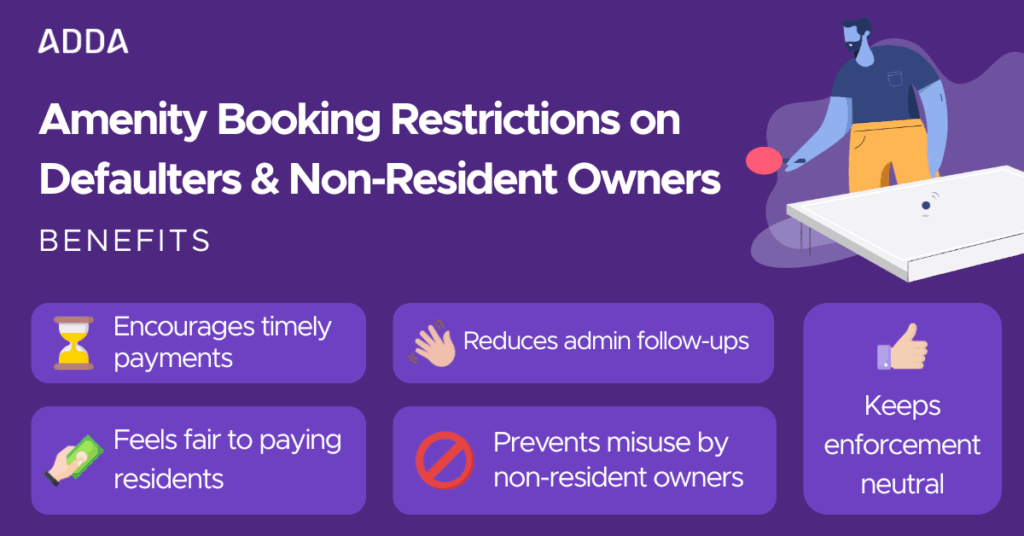
- Encourages timely payments
Residents are gently nudged to clear pending dues at the moment they try to book an amenity, without reminders or pressure from admins. - Reduces admin follow-ups
Chronic defaulters no longer require repeated calls, messages, or manual tracking by the Management Committee. - Feels fair to paying residents
Amenities are not freely used by residents who delay payments or by owners who do not live in the community. - Prevents misuse by non-resident owners
Communities can ensure that shared facilities are primarily available to people who actively reside in the association. - Keeps enforcement neutral
Rules are applied consistently by the system, not selectively by individuals, which helps avoid personal conflicts.
How it works
Step 1:
The Management Committee sets an overdue dues limit in the ADDA ERP.
Step 2:
The system checks overdue dues and unit occupancy automatically during amenity booking.
Step 3:
Residents above the dues limit, or owners of tenant-occupied units where enabled, are restricted and shown a clear system message.
Step 4:
Once dues are cleared or eligibility changes, amenity booking access is restored automatically.
Residents can still view amenity availability even when booking is restricted, so they know what becomes accessible once conditions are met.
Conclusion
Managing maintenance collections should not depend on endless chasing or uncomfortable enforcement.
By linking amenity access to maintenance responsibility — and aligning bookings with actual residency where required — ADDA gives Management Committees a practical and balanced way to deal with chronic defaulters without affecting essential services.
Set the rule once, let the system enforce it consistently, and focus your time on running the community smoothly.
For any questions or help with setup, reach out to support@adda.io.