Once a residential community crosses 400 or 500 homes, things change.
At that size, the community is no longer just managing a gate and a few notices. It is managing finances, assets, complaints, amenities, vendors, staff, compliance, records, and day-to-day coordination between hundreds or sometimes thousands of people.
That is why large communities eventually stop saying, “Let’s use whichever software is cheapest in the market” and start asking a more serious question:
“Does our technology platform actually support our needs to run a large community properly?”
That is the real issue.
Because in a large apartment complex, software is not just a checklist tool. It becomes the operational backbone of the community.
These 4 pillars bring together the 12 operational capabilities large communities need to run smoothly, securely, and compliantly.
Let us go through those 4 pillars, and their building blocks one by one.
Table of Contents
Pillar 1. Clean Communication & Privacy-First Resident Experience
Impact:
Saves 8+ hours of resident time every month and reduces workload of MCs and Estate Managers by up to 25%. It also helps remove the risk of ₹250 crore non-compliance penalties through a DPDP-compliant Consent Manager.
Large communities need residents to trust the app as the official place for announcements, invoices, alerts, bookings, complaints, and visitor approvals. If the app is cluttered with advertisements or promotional notifications, communication starts losing effectiveness. Under the DPDP Act, if ads are being shown, the platform must have a proper Consent Manager with explicit resident opt-in / opt-out.
Includes:
• Clean Communication — No Ads
• One-Click Resident Access to Bill Payment, Helpdesk, Amenity Booking, Visitor Approvals
• DPDP-Compliant Consent Manager
Building Block 1: Clean communication — Without Ads/Spam
Why Is Clean, Trustworthy Communication the First Pillar for Large Communities?
When living in a community, where amenities and different facilities are shared – shared lift, lobby, play areas, water, power; communication between the community management team and the residents/owners, and vice versa, is the first thing which needs to be sorted out. This means having an official platform through which this communication can happen.
Though this is the most basic requirement, this is where most communities struggle, because they do not pay enough attention and importance to this basic need. Communication problems usually do not begin because committees are not communicating. They begin because many communities do adopt a clean official channel for communication.
Oh, and if you are thinking that having an ad/spam filled community app can be named an official communication, it just cannot happen. Can you imagine your kids’ school using a platform to send you updates on homework and school related activities through a product which is at the same time filled with spam? It just doesn’t work.
In many communities, residents receive too many irrelevant notifications, forwarded messages, or cluttered updates. Over time, they stop paying attention. Then one day, an important water shutdown notice or AGM update gets missed, and frustration begins on both sides.
A large community needs one official communication channel that residents can trust, and this channel obviously cannot have any advertisements.
Why this matters in practice:
When communication is clean, residents actually read it. That sounds simple, but it changes everything. Fewer calls come to the management office. Fewer misunderstandings happen. The committee spends less time repeating the same updates.
Real Life Scenario
At 7:30 pm, the estate manager sends a notice that water will not be available the next morning because of urgent municipal line maintenance work. He also advises the residents to keep some water in backup, as it would take some to finish the municipal line work and water tanker will take some time to come.
In an ad-filled community app, many residents miss it and wake up to find no water in the taps. What follows is chaos! In a clean official communication system, residents see the alert clearly, plan ahead, and the next morning passes without chaos.
Real Impact in a Community
When community communication is cluttered with irrelevant messages, residents stop paying attention. Important updates get missed and the MC ends up answering the angry residents complaining about missed updates or answering the same questions repeatedly.
What is the impact in communities using clean, ad-free communication platforms like ADDA?
• Residents save 8+ hours every month because they don’t have to sift through promotional noise and spam.
• The workload of the MC and Estate Manager reduces by up to 25% because residents read notices the first time.
• Residents begin trusting the app as the official source of information.
In practical terms, this means fewer phone calls to the office asking, “Is there really a water shutdown tomorrow?” Residents see the notice clearly and plan accordingly.
What should a large housing society communication platform do?
A large housing society communication platform should adopt a clean, official, distraction-free channel for community notices, maintenance updates, AGM announcements, and policy communication. Residents should be able to trust that all notifications from this platform are important and community-related.
Building Block 2: One-Click Access to Bill Payment, Helpdesk, Amenity Booking, Visitor Approvals in Resident App
Why Is One-Click Resident Self-Service So Important in Large Apartment Complexes?
In a small building, residents may not mind calling the association office for every little thing.
In a large community, that model breaks very quickly.
The whole purpose of adopting a community app is so that residents should not have to chase the office for routine actions. A technology platform for large communities should make common resident tasks simple and fast.
What residents should be able to do easily:
- pay maintenance dues
- submit complaints and maintenance service requests
- approve visitors, preauthorise visitors
- book amenities
- view community rules and notices
- track requests without calling staff repeatedly
Why this matters in practice:
When residents can complete daily actions in one or two steps through an App or Portal, the operational load on the community team drops sharply.
This is one of those pillars that directly affects both sides. Residents feel the system is efficient and experiences first hand convenience around every society operation. The management team feels the system is manageable.
Real life scenario
A resident returning from work remembers at 10:15 pm that he needed to get the leaking basin fixed before his parents visit which was scheduled for the weekend. He also wanted to quickly book the badminton court for the Friday evening slot. He also wanted to pre-approve an early morning electrician visit. In a good platform, all three actions happen within a minute from the same app. No calls. No waiting. No confusion.
In an Ad-Filled platform the same set of tasks would take more than 15 mins. And more often than not, the resident would feel so tired and frustrated after doing a couple of tasks in the App, he would probably never do the third task.
Real Impact in a Community
Large communities generate hundreds of small operational requests every day. If residents depend on the association office for everything, the system slows down very quickly.
What is the impact when daily resident actions move to self-service inside the ADDA resident app?
- All Residents combined save 200+ hours every month completing routine tasks themselves.
- MC and estate manager workload drops by up to 30%.
- Residents can complete tasks instantly instead of waiting for office hours.
Instead of calling the association office to submit a complaint, maintenance service request or book a sports court, residents simply open the app and complete the action in seconds. Across hundreds of homes, this creates massive time savings.
What features should residents get in a community management app like ADDA?
Residents in a large community management app should be able to pay bills, raise complaints, approve visitors, book amenities, and access important notices quickly from one place. This reduces dependency on the management office and improves everyday convenience.
Building Block 3: DPDP-Compliant Consent Manager
Why Is DPDP-Compliant Consent Management Now a Serious Pillar?
Many communities still think that showing advertisements inside the Community Apps are perfectly fine.
It is not.
Housing societies collect sensitive resident data. That includes phone numbers, apartment information, vehicle details, visitor records. With the DPDP Act coming into force, much has changed with respect to how community apps can function, and around the responsibilities of the management committee members.
What is the DPDP Act saying with respect to housing societies?
The DPDP Act which is in effect since Nov 2025, makes it very clear that:
- Management Committees are now named as Data Fiduciaries. This is because the management committee is the entity which “determines the purpose and means of processing of personal data“ in a housing society – quoting the words from the Act.
- Community Apps are named as Data Processors – processes personal data on behalf of a Data Fiduciary – quoting the words from the Act.
- Resident data can be used for the purpose for which it was collected in the first place – which is society communication and operations. This is called Purpose Limitation according to the Act. Hence this makes showing ads inside your community App illegal
- Ads or other promotions can be shown inside the Community App, only for residents who have given explicit permission for it. This is called Explicit Consent as per the Act.
What should Associations / RWAs / Management Committees / MCs now need to make sure regarding the DPDP Act?
MCs are hence, now legally responsible to ensure Digital Personal Data is used with Purpose Limitation and Explicit Consent. Since the Penalty Clause is steep (Rs.250 Crore), it is mandatory for management committees to make sure their community app:
- Has a consent manager built in
- Only residents who have given consent to seeing promotions (through the consent manager), are shown ads
- Is not charging anything extra to remove consent – as the Act make it very clear – Removing consent should be as easy as providing the consent
If a platform mixes official communication with unrelated promotional messaging or uses resident data carelessly, the committee can be exposed to risk.
Hence a DPDP Compliant technology platform should support:
- clear separation of official and promotional communication
- explicit consent workflows
- resident data protection
- compliance-oriented data handling
Why this matters in practice:
A consent management framework aligned with privacy regulations helps communities reduce serious non-compliance risk.
For committees, this is no longer optional. If resident data is being processed, it must be handled responsibly through a consent manager framework.
Real life scenario
A resident asks the committee why he is receiving promotional messages through a platform that the association uses for maintenance notices and security alerts. If there is no consent structure, the committee has no clean answer. If the platform is built correctly, the distinction is clear, the consent is documented, and the committee is protected.
Real Impact in a Community
How does a consent management system like ADDA, protect the community from non-compliance penalties of up to 250 Crores?
• Preventing misuse of resident data
• Ensuring promotional communication happens only with consent
This is not just about compliance. It reassures residents that their personal information is being handled responsibly by the community
Why does a housing society app need consent management?
A housing society app needs consent management to ensure resident data is used only for legitimate community purposes unless explicit permission has been given for other communication. This supports privacy compliance and protects both residents and the management committee.
Pillar 2. Robust Billing, Collections & Financial Control
Impact:
A strong financial backbone can reduce defaulters to near zero and reduce community expenses by up to 18% through better budget controls, purchase governance, and maker-checker approvals.
Large communities need more than invoice generation. They need law-compliant billing, automated collections, reconciliation, defaulter tracking, expense governance, budget comparisons, purchase workflows, and full audit trails. This is what allows MCs and treasurers to manage crores of rupees with transparency and control.
Includes:
• Law-Compliant Billing, Proven Defaulter Reduction Engine
• Expense Governance & Budget Controls
Building Block 4: State Laws Compliant, Defaulter reduction targeted Billing
Why Is Legally Defensible Billing a Core Pillar for Large Communities?
If you ask treasurers what causes the most stress, billing and collection will always be near the top.
Once a community becomes large, maintenance billing is no longer a simple exercise. There may be multiple billing heads, different formulas, late payment interest calculations, corrections, reconciliations, and resident queries. If this is not handled well, the finance side becomes a constant source of disputes.
A serious platform for large communities should support:
- automated invoice generation
- flexible billing configurations
- online payment collection
- reconciliation
- defaulter tracking and reduction mechanism
- late payment interest calculations
- debit and credit notes
- collection reports
Why this matters in practice:
Large communities manage serious money. Billing for such large communities must be transparent, robust, and aligned with local housing requirements. Strong billing capability helps reduce defaulters significantly.
Residents do not merely want a bill. They want a bill they can understand. Committees do not merely want collections. They want collections backed by a defensible process.
Real life scenario
The treasurer of a 750-unit community is asked during the AGM why late payment interest was applied to a particular flat. Instead of searching through spreadsheets and email threads, she opens the system, pulls up the invoice trail, the payment history, the configured rule, and the exact calculation. The discussion ends in two minutes instead of becoming a thirty-minute argument.
Real Impact in a Community
Maintenance billing becomes increasingly complex as communities grow larger. Multiple billing heads, penalties, corrections, and reconciliations can quickly create confusion.
What outcomes does a structured billing engine, like ADDA, deliver?
• Defaulters reduce to near zero because invoices are clear and timely.
• Residents receive automated reminders, improving payment discipline.
• Treasurers spend far less time chasing payments or resolving disputes.
For many treasurers who already have full-time jobs, this reduces hours of follow-up work every month and significantly improve community cash flow
How should large apartment communities manage maintenance billing?
Large apartment communities should use a structured billing system like ADDA, that automates invoice generation, payment tracking, reconciliation, defaulter reporting, and late payment calculations. This improves transparency, reduces billing errors, and supports legally defensible financial operations.
Building Block 5: Expense Governance & Budget Controls
Why Are Budget Controls and Expense Governance Non-Negotiable for Large Communities?
The larger the community, the bigger the financial exposure.
A big apartment complex handles a few crores in annual expenses. At that scale, informal approvals and scattered records are not just inefficient. They are risky.
A proper expense governance pillar should support:
- annual budgeting and expense planning
- budget comparisons across years
- real-time tracking of actual versus planned spend
- purchase requests and purchase orders
- goods or service receipt workflows
- payment approvals
- maker-checker controls
Why this matters in practice:
This pillar helps reduce expenses and eliminate financial misappropriation risk through structured controls and audit trails.
Good governance is not about making life harder for the community team. It is about making sure that dependence on structured processes increases rather than dependence on manual processes, on memory, informal chats, or verbal approvals when money is involved.
Real Life scenario
A generator repair quotation of ₹2.8 lakh is approved informally on a committee WhatsApp group. Three months later, another committee member questions why this vendor was chosen and whether the spend was within budget. It takes almost 2 hours for the estate manager and accountant to put together the justification. A good amount of time of the Treasurer also goes into this.
In a system like ADDA, with a proper expense workflow, the quotation, approval path, budget visibility, and payment trail would all be linked. That one workflow saves hours of reconstruction later.
What is the real impact of using ADDA’s governance-driven expense workflows?
Large apartment complexes manages annual budgets running into crores of rupees. Without structured financial workflows, even simple purchases can become chaotic. Communities which use ADDA are able to demonstrate tangible reduction in expenses, and also significant time savings and reduction in accountant’s cost. ADDA brings in:
- Up to 18% reduction in overall community expenses
- Clear approval workflows for purchases, and full audit trails for financial transparency which saves upto 28% of an accountant’s time – saving time spent on making manual entries and creating reports
- Saves upto 20+ hours of a Treasurer, getting reports and transactions details together during reconciliation exercises or audits
With ADDA, every financial decision, from purchase requests to payments, is documented and traceable, making audits and financial reviews much easier.
What financial controls should a large housing society platform have?
A large housing society platform should have budgeting tools, expense approval workflows, purchase requests, payment approvals, and audit trails. These controls help communities manage large budgets responsibly and transparently.
Pillar 3. Proven Gate Management & Access Control
Impact:
Reduces wait time at the gate by 50% and gives the community 80% better incident investigation capability. With the right integrations, it also helps large communities run high-volume gate operations without manual confusion or fragmented systems.
In large communities, gate operations include visitor entry and exit, staff movement, delivery tracking, parcel handling, resident access, guard patrolling, and access control integrations. A proven system ensures these movements are handled quickly, securely, and with accurate digital records.
Includes:
• Integrated Visitor, Staff, and Delivery Management
• Integrations & Partnerships
Building Block 6: Integrated Visitor, Staff, and Delivery Management
Why Must Visitor, Staff, and Delivery Management Be Fully Integrated in an Online Platform?
In a large community, the gate is a high-volume operational point.
Visitors, domestic staff, delivery personnel, service technicians, and residents are all moving through the premise’s gate daily. When records are fragmented or manual, incident investigations become harder, over security infrastructure becomes weaker, and staff spend too much time on repetitive coordination.
A strong gate management pillar should include:
- visitor approvals
- staff entry management
- parcel management
- guard patrolling systems
- access control integrations
Why this matters in practice:
Integrated visitor, staff, and delivery management greatly improves incident investigation capability.
In large communities, the value of gate records is often realized only after something goes wrong. That is too late. This pillar matters precisely because it prepares the community before an incident occurs.
Real life scenario
A parcel meant for a resident goes missing after it was accepted at the gate. In a weak system, the guard vaguely remembers taking it. In a strong integrated system, the parcel entry, timestamp, photo, and handover trail are visible immediately. What could have turned into an ugly dispute gets resolved quickly.
Real Impact in a Community
Security in large communities depends heavily on accurate entry records.
What impact does an integrated gate management system like ADDA provide?
- 80% better incident investigation capability
- Less queue and waiting time at gate. Visitors are able to enter with 50% less wait time at the gate
- Digital logs for visitors, staff and deliveries are maintained which results in up to 80% faster response when something unusual happens
If a package goes missing or an unauthorized person enters the premises, the committee can immediately check records instead of relying on memory or incomplete registers.
Why do large housing societies need integrated visitor and staff management?
Large housing societies need integrated visitor, staff, and delivery management because high entry volumes require accurate digital records, quick approvals, and searchable logs. This improves security, accountability, and incident investigation.
Building Block 7: Integrations & Partnerships
Why Are Integrations and Partnerships the Final Pillar for Large Communities?
A large residential community does not run on software alone. It runs on a mix of software, hardware, financial systems, access systems, and utility systems.
If these remain fragmented, the management team ends up working across disconnected tools all day.
A future-ready platform should support integrations with:
- Access control systems
- Utility systems
- Payment systems
- Accounting-related workflows
- Relevant hardware and software ecosystem partners
Why this matters in practice:
The community management software usually becomes the backbone that connects the ecosystem of hardware and other software systems used in large communities. Deep integrations help communities avoid fragmented operations.
This is the pillar that often separates basic apps from serious large-community platforms. A large community does not just need features. It needs an operating backbone.
Real Life scenario
The community has access control hardware at the clubhouse which is used by residents to access amenities like Gym.
The community has to maintain 2 separate databases – one in the ERP, and other in the clubhouse access control system. This becomes a pain, as whenever a tenant moves in/out, the details need to be updated in both the systems.
This not only takes time, but at times the community management team had mistakenly removed access of current residents while trying to update the records of tenants who have moved out, in the access control system. Incidents like these cause significant chaos inside communities.
In another incident when the MC needed to study the report of Gym usage to investigate a case of broken treadmill, they were not able to access the reports because the login credentials were not available. The login credential was given to only one MC member, and as the access control system is usually not logged into often, he was not able to find the login credentials. The management committee ended up wasting some hours trying to get the access credentials reset from the access control team.
With fragmented systems, reports have to be manually pulled from different places. Once these systems begin speaking to one platform, the manager gets a unified view instead of juggling operational fragments.
What is the real impact of an ERP system like ADDA, which has strong integrations with multiple hardware and software systems?
Modern residential communities use multiple systems — access control hardware, utility meters, payment gateways, and security tools. With ADDA, instead of operating multiple disconnected systems, the community runs everything through one centralized digital backbone.
Platforms like ADDA, with strong integrations offer:
• 50+ integrations across software and hardware systems
• Unified operational visibility and Reduced manual coordination between different tools ends up saving 10+ hours of management committees’s and estate manager’s time in a month
Why do large apartment communities need software integrations?
Large apartment communities need software and hardware integrations because operations depend on multiple systems such as access control, utilities, and payments. A connected platform reduces fragmentation and gives the management team a unified operational view.
Pillar 4. Complaint Management, Amenities/Clubhouse Management & Daily Community Operations
Impact:
This pillar can improve helpdesk resolution efficiency by 35%, raise resident satisfaction scores to up to 95%, reduce community manager workload by up to 8%, reduce repair and maintenance costs by up to 22%, save up to 55 hours of community manager time every month, and save up to 30 hours monthly through centralized records and documents.
Residents judge the platform by how easily they can raise a complaint, book an amenity, track progress, access records, and get things done without friction. Managers need structured workflows for helpdesk, amenity controls, asset maintenance, operational approvals, and centralized master data. Together, these systems keep large communities running smoothly every day.
Includes:
• AI-Powered Helpdesk with Multi-Language Support
• Fast Amenity Booking with Flexible Controls
• Asset Management with Service History and AMC Calendars
• Process-Controlled Community Operations
• Centralized Operational Records, Documents and Master Data
Building Block 8: AI-Powered Helpdesk with Multi-Language Support
Why Is an AI-Powered, Structured Helpdesk a Must for Large Communities?
In large communities, complaints do not come one by one. They come in waves.
Plumbing issues, electrical problems, security concerns, housekeeping requests, maintenance follow-ups, recurring complaints. If these are not routed, tracked, escalated, and closed systematically, residents lose faith very quickly. That’s the community manager’s side of things.
For residents, you need a system which is quick and flexible to capture the complaints, queries or the maintenance service requests and submit them to the community helpdesk team.
What are the necessary features of a community helpdesk system for residents?
- Easy access to the helpdesk, so that residents don’t need to hunt for the feature. This is where an Ad first community app fails. Residents in communities using Ad first community apps, have to hunt through banners and promotions which take up 50-70% of the app screen, making it very difficult to find essential information and services like helpdesk. For senior citizens it becomes an impossible task to find services like helpdesk in an Ad first community app.
- Ability to quickly explain the complaints, queries or the maintenance service request, and ability to submit to the community helpdesk team. This is best done when residents are able to express their help desk request in any language they are comfortable with, and they are not compelled to type their issue in a form.
A serious helpdesk pillar, for residents, should include:
- Ability to find the help desk option without having to hunt between promotions and advertisements
- Voice support for submitting helpdesk requests
- Ability to speak in any language for explaining the request, complain or query
- Transparent status tracking
For the community management team, helpdesk should include features like:
- complaint routing and categorization
- escalation workflows
- vendor coordination
- satisfaction ratings and reports
Why this matters in practice:
AI-powered helpdesk with multilingual support can significantly improve resolution efficiency and resident satisfaction.
This is especially important in India, where residents may be more comfortable describing problems in their own language. Thoughtful technology should adapt to that reality, not force everyone into rigid formats.
Real life scenario
An elderly resident notices water seepage near her kitchen and speaks her complaint into the app in her preferred language. The system captures it, routes it correctly, and the ticket begins moving.
Without such a system, she may have to maybe wait for her working daughter/son/son-in-law or daughter-in-law to type the request for her, or she would have had to call multiple people, repeat herself several times, and still worry whether anyone actually understood or noted the complaint.
Real Impact in a Community
Large communities may handle thousands of complaints every month. Without a structured system, many of them get delayed or lost.
What impact does AI-driven helpdesk systems like ADDA bring to a community?
In an AI powered system like ADDA, residents can describe their problem in their preferred language, just by speaking to the App, and the system automatically routes it to the right maintenance team. This dramatically improves response speed. This brings in significant impact to a community:
• 35% improvement in complaint resolution efficiency
• Resident satisfaction scores reaching up to 95%
What kind of help desk system do large apartment communities need?
Large apartment communities need a structured helpdesk system that routes complaints automatically, tracks status transparently, supports escalations, and helps residents raise issues easily. This improves resolution speed, accountability, and resident satisfaction.
Building Block 9: Fast Amenity Booking with Flexible Controls
Why Is Fair, Flexible Amenity Booking One of the Core Pillars?
Shared amenities are where community goodwill can either improve or break down.
If booking systems are unclear, too primitive, or filled with spam/ads, resentment within the residents builds fast. Residents start feeling that they are not able to enjoy the community living to the fullest. In large communities, sports facilities like badminton courts, tennis courts, etc. are usually high in demand and gets booked quickly, quite in advance. If residents have to hunt for these booking options within a spam filled community app, then the whole experience of amenity booking becomes extremely frustrating for residents.
What results are raising complaints from residents regarding the fairness of the amenity booking system, arguments regarding bookings with the association and escalations to the management committee members.
An amenity booking platform, for residents, should include:
- Ability to find the amenity booking option, in one tap once you open the Community App, without having to hunt between promotions and advertisements
- Ability to check availability of various amenities
- Book within seconds and make payments too
An amenity booking platform for community management teams, in a large community should support:
- slot-based booking
- hourly and daily reservations
- prime slot configuration
- usage restrictions per apartment
- block-wise access rules
- advance booking limits
- automatic cancellations and deposits
Why this matters in practice:
Flexible amenity booking improves utilization of the amenities and reduces manager workload.
This is not just about convenience. It is about fairness. In a large community, perceived fairness matters as much as the actual booking process.
Real life scenario
In a 900-home complex, evening badminton slots are always being taken by a small group. Complaints keep piling up. Once the community adopted ADDA, the platform introduced weekly limits that prevented back-to-back monopolization, and also the community app became ad free, where residents started finding the amenity booking option easily.
The result was – resident complaints stopped. Nothing magical happened. The system simply made fairness visible.
Real Impact in a Community
Shared facilities like badminton courts or clubhouses often become sources of conflict if booking systems are unclear.
How does automated and ad-free booking systems like ADDA, help in better managing amenities in large communities?
Residents can see available slots instantly and book facilities without having to hunt through irrelevant promotions and spam, reducing disputes and confusion. The community management team also gets equipped with robust and flexible configurations to ensure online booking and fair usage of amenities. The impact is significant:
- Reducing community manager workload by up to 8%
- Increasing overall facility utilization – which increases revenue collection for communities by up to 18% for communities who charge for clubhouse amenity usage
- Surveys have shown that communities who use ADDA’s amenity booking features, are able to ensure fair access to amenities, which increases resident satisfaction to up to 95%.
How should large communities manage amenity bookings?
Large communities should use an amenity booking system with slot controls, usage limits, booking rules, and transparent availability. This ensures fair access to shared facilities and reduces booking-related disputes.
Building Block 10: Asset Management with Service History and AMC Calendars
Why Is Asset Management a Major Pillar for Large Residential Communities?
Residents usually notice infrastructure only when it fails.
The lift stops. The water pump has an issue, because of which water supply stops to the apartments. The generator does not start properly during a power cut. The fire system inspection was missed, because of which a fire in a common area during Diwali goes out of control.
These are not minor inconveniences. In large communities, they affect hundreds of households immediately, and also results in lakhs of money lost in repair and damage control.
A strong asset management pillar should include:
- asset registers
- service history tracking
- AMC calendars
- depreciation calculations
- QR-based asset tagging
- helpdesk integration with asset records
Why this matters in practice:
Proper asset management can reduce repair and maintenance costs and improve continuity of records.
This is a classic case of invisible value. Good asset systems do not always produce dramatic daily visibility. What they do is prevent expensive surprises.
Real life scenario
A pump fails during peak summer demand. In a weak system, the team scrambles to figure out the service vendor, warranty status, and last maintenance date.
In a community using ADDA, that information is already available. The response is faster because the memory lives in the platform, not in one person’s inbox.
What real impact can structured asset tracking system like ADDA provide to a housing society?
Large communities maintain hundreds of infrastructure assets including lifts, pumps, generators, and fire safety equipment. Use of a proper asset management system like ADDA can bring in significant benefits:
- Up to 22% reduction in repair and maintenance costs
- Better preventive maintenance planning and clear service history for every asset results in saving up to 30+ hours in a year for the Association or MCs – reactively taking care of asset and equipment repair and damage control
When maintenance teams know exactly when equipment was last serviced and when the next AMC is due, expensive breakdowns almost always gets avoided.
Why do apartment complexes need asset management software?
Apartment complexes need asset management software to track service history, maintenance schedules, AMC renewals, and infrastructure records for lifts, pumps, generators, and other critical assets. This reduces breakdowns and improves long-term cost control.
Building Block 11: Centralized Operational Records, Documents and Master Data
Why Must Large Communities Centralize Operational Records, Community Documents and Master Data?
Large communities generate a huge amount of operational information over time – Vendor details, staff records, vehicle records, meeting minutes, resolutions, documents, parking allocations, community policies. If these are scattered, the society keeps losing time rediscovering what it already knows.
A solid records pillar should centralize:
- Meeting minutes and resolutions
- Vendor master records
- Staff records
- Vehicle records
- Community documents
Why this matters in practice:
Centralized records save time and make retrieval easier during audits, decisions, and governance reviews.
This becomes especially valuable during committee transitions. A new team should inherit a working system, not a mystery.
Real life scenario
A new treasurer joins the committee and wants to know the discussion details and final resolution passed last year about reserve fund usage for repainting. If the details of the discussion and the resolution is buried in email threads and forwarded PDFs, the search becomes painful and wastes a lot of time.
If it is part of a proper central record system, the answer is available immediately.
What real impact does a centralized records system like ADDA, have on a housing society?
In many communities, critical information is scattered across emails, spreadsheets, and paper files. In a system like ADDA, instead of hunting through old emails and goggle drives of files in almirahs in the association office to find meeting decisions or vendor agreements, everything is stored in one structured platform, in organised folders.
A centralized system like ADDA, for maintaining records can have significant impact:
- Saving up to 30 hours of manager time every month
- Making documents easy to retrieve during audits, preserving institutional knowledge when committees change – ends up saving 50+ hours of management committee members time over a period of a year
What records should a large housing society keep in one platform?
A large housing society should centralize meeting minutes, vendor records, staff details, vehicle data, and community documents in one platform. This improves operational continuity, governance, and record retrieval.
Building Block 12: Process-Controlled Community Operations
Why Do Large Communities Need Process-Controlled Community Operations?
In large communities, operations become too complex to run through memory or informal coordination alone.
Move-ins, move-outs, violation handling, staff coordination, renovation permissions, approvals, office tasks, manager follow-ups. All of these need process discipline.
A large-community platform should support:
- violation tracking
- move-in and move-out management
- community forms and approvals, automated permit generations
- staff coordination
- mobile access for community managers
Why this matters in practice:
Process-controlled operations save significant community manager time every month.
This is one of the most underrated pillars. Communities often feel the pain here without naming it properly. What they are really suffering from is process leakage. Things are being done, but not in a repeatable, visible, trackable way. Because of this, the community management team is always overworked, and overwhelmed, without having time to focus on real projects which can increase the property value in the long term or resident engagement activities.
Real life scenario
A tenant is moving in on Saturday. The office needs IDs, NOC details, move-in timing, lift protection planning, and staff coordination. In a weak system, this happens through multiple calls and last-minute confusion.
In a process-driven system like ADDA, the form, approval, timing, and coordination all happen in sequence, without the chaos of multiple emails, or the tenants having to visit the association office.
What real impact does structured operational workflows like ADDA, have on a residential community?
Managing move-ins, renovations, violations, and staff coordination manually can consume a large portion of the estate manager’s time. Having a system like ADDA, frees up the management team to focus on improving services instead of handling repetitive administrative work. The impact is significant:
- Save up to 55 hours of community manager time every month
- Resident surveys in communities using ADDA, have found that standardized operational processes, and improved coordination between residents, staff, and vendors, becomes a major factor in increasing resident satisfaction score to up to 97%.
How do large residential communities standardize daily operations?
Large residential communities standardize daily operations through structured workflows for move-ins, approvals, staff coordination, violations, and community forms. This reduces confusion and helps managers handle operations consistently at scale.
What Do These 4 Pillars Really Mean for a Large Community?
When you step back and look at these 4 pillars and the 12 building blocks together, a larger truth becomes obvious.
A large apartment community does not merely need an app.
It needs a platform that can function as the digital operating system of the community.
That means:
- communication residents trust
- services residents can use easily
- finances the committee can defend confidently
- operations the manager can actually control
- records the next committee can inherit without chaos
That is the real benchmark.
Not whether the platform is offering advertisement revenue to the community.
The real question is this:
Can it support the 4 pillars, and 12 building blocks that large communities actually need to run properly?
That is the conversation serious communities should be having. And that is the conversation which well run communities have when evaluating a software as the community management platform. This is the lens through which any large housing society should evaluate technology.
What are the 4 pillars and 12 building blocks large communities need from a technology platform?
Large apartment communities need a technology platform that supports 12 building blocks: clean communication through ad-free resident app, resident self-service, robust billing and defaulter reduction engine, integrated visitor and staff management, DPDP Act compliant consent management, Voice AI Powered and structured community helpdesk, easy to use and fair amenity booking, expense governance, asset management, centralized records and documents, process-controlled operations, and integrations.
Together, these capabilities help communities run property, are able to provide good living experiences, and ultimately result in increased property value in the long run..
What Is the Total Impact of a system like ADDA, in a 1,000 Apartment Community?
When each of the 4 pillars, the 12 operational building blocks, works together, as in a system like ADDA, the combined impact becomes surprisingly large. Instead of small improvements in isolated areas, the community experiences improvements across time, finances, and operational efficiency simultaneously.
Below is what the combined impact can realistically look like for a 1000-home residential community.
1. Total Resident Time Saved
Residents interact with the community system every day — paying bills, raising complaints, approving visitors, checking notices, or booking amenities.
When these tasks move into a structured resident app, the time savings add up quickly.
Per Resident
- 2.5+ hours saved every month due to clean communication without irrelevant notifications
- 4+ hours saved every month through one-click access to payments, visitor approvals, complaints, and bookings.
Total resident time saved
• 6.5+ hours per resident per month
Community-Level Impact (For 3,000 residents of the community)
• 19,500+ hours saved every month
• 2,34,000 hours saved every year
To visualize that scale:
That is equivalent to over 26 years of human time returned to residents every single year.
2. Total Time Saved for Community Management Teams
Community managers and MC members often spend their evenings or weekends coordinating operational tasks.
Structured workflows in a system like ADDA, significantly reduce this administrative burden.
Monthly Operational Efficiency Gains from a system like ADDA
• Up to 30% reduction in operational workload due to resident self-service.
• 30 hours saved every month through centralized operational records.
• 55 hours saved every month through structured operational workflows.
Total operational time saved
• 85+ hours saved per month for the community management team
Annual Impact
• 1,020 hours saved every year
That is equivalent to more than 25 full working weeks of management time recovered annually.
Instead of chasing approvals, searching records, or coordinating routine tasks, the management team can focus on improving community services.
3. Total Financial Impact for the Community
Large residential complexes often manage annual budgets ranging from ₹5 crore to ₹10 crore.
Small improvements in financial governance therefore translate into significant monetary impact.
Financial Improvements Enabled by a system like ADDA
• Up to 18% reduction in community expenses through structured budget controls and approval workflows.
• Up to 22% reduction in repair and maintenance costs through preventive asset management.
• Near-zero defaulters through automated billing and reminders.
Realistic Financial Impact
For a community with a ₹7 crore annual operating budget:
On the income side potential improvements may include:
- Improved cash flow due to faster maintenance collections, and near zero defaulters.
- Within one quarter of implementation of ADDA, typically the defaulters’ percentages reduce to around 5% – For a 1,000 unit community, this typically means around Rs. 50 Lakhs to Rs. 1 crore extra collection after the community implements ADDA.
On the expense side potential improvements may include:
- ₹20 lakh – ₹50 crore savings annually through better expense governance
- ₹15 lakh – ₹30 lakh savings annually through preventive asset management
This means communities may unlock up to ₹1 crore or more of financial efficiency every year simply through better operational systems.
4. Security and Incident Response Improvements
Security is another area where the combined impact becomes visible quickly.
Integrated visitor and staff management systems like ADDA, provide:
- 80% better incident investigation capability
- Less queue and waiting time at gate. Visitors are able to enter with 50% less wait time at the gate
- Digital logs for visitors, staff and deliveries are maintained which results in up to 80% faster response when something unusual happens
For communities with thousands of daily entries, this greatly improves accountability and response capability.
5. Compliance and Risk Protection
Communities also benefit from stronger legal protection.
DPDP Compliant consent-based communication frameworks ensure:
• compliance with privacy regulations
• proper separation of official and promotional communication
• protection from penalties that can reach ₹250 crore under privacy regulations
Today, residential communities are also increasingly receiving GST and taxation related notices.
With a system like ADDA, responding to such notices becomes easy through readily available clear accounting records, invoice history, transaction records and supporting documentation going back multiple years. This saves the community from incurring GST/Tax penalties going up to tens of lakhs of rupees, significant time loss, compliance stress and operational disruption.
The Combined Impact
When all 12 operational building blocks as part of the 4 pillars are implemented together, the improvements compound.
A large residential community can realistically experience:
Annual Resident Impact
• 2,34,000 hours saved every year
Annual Management Impact
• 1,000+ hours of community management time recovered
Annual Financial Impact
• ₹70 lakh – ₹1 crore+ improvement in financial efficiency
Compliance and Risk Protection
- Community is saved from potential crores of penalties from GST/Tax/DPDP Act compliance problems which can easily come from using ad-based and un proven ERP systems
Operational Improvements
- Stronger security investigations
- Better compliance with privacy laws
- Fewer disputes between residents and management
- Faster daily operations across the community
Conclusion
In the long run, every decision a community makes about how it manages operations quietly shows up in one place — the condition and value of the property itself.
A large residential complex is not just a place where people live today. It is also a long-term asset that residents and owners have invested in. When maintenance is handled well, finances are governed transparently, infrastructure is serviced on time, and communication between residents and the management team works smoothly, not only only does the residents get a great living experience, but also the community gradually becomes more well maintained and more desirable for Tenants, and new owners who wants to own a property..
This is where the 12 operational building blocks, as part of 4 pillars discussed in this article, start connecting to something bigger. Clean communication improves coordination. Structured helpdesk systems ensure maintenance issues are resolved faster. Asset tracking keeps critical infrastructure like lifts, pumps, and generators serviced on time. Expense governance prevents waste and keeps finances stable. Security systems maintain safety and trust. And centralized records ensure that every new management committee continues from where the previous one left off instead of starting from scratch.
Over the years, these operational improvements translate into better-maintained infrastructure, smoother daily life for residents, and stronger financial discipline within the community. When prospective buyers or tenants visit such a property, they notice the difference immediately — the buildings are maintained better, complaints are handled efficiently, facilities are usable, and the overall environment feels well managed.
That ultimately reflects in higher desirability and stronger property values for everyone who owns a home in the community.
For Management Committees and Resident Welfare Associations, the question therefore is not just about adopting technology or improving processes. It is about asking a broader question:
Are we putting the systems in place that will protect and enhance the value of our community over the next 10–20 years?
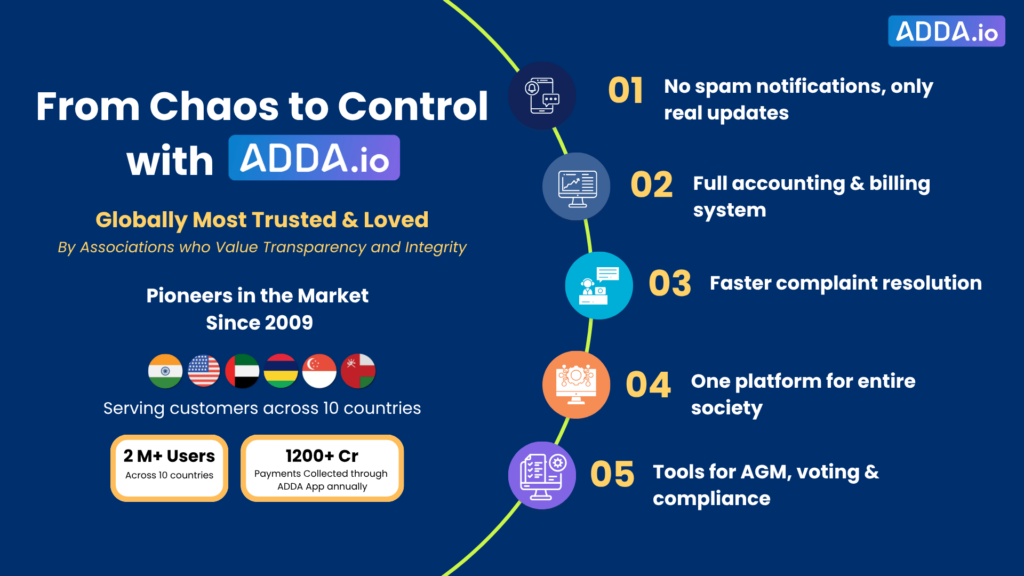
👉 If your community is evaluating how to strengthen these foundations, explore how large residential communities manage these 12 operational building blocks, as part of the 4 pillars, using platforms like ADDA.io. You can also schedule a walkthrough to see how communication, finances, security, and daily operations can run through one structured system.
Because in the end, when communities run well operationally, everything else improves too — resident satisfaction, financial stability, infrastructure longevity, and ultimately the long-term value of the property itself.