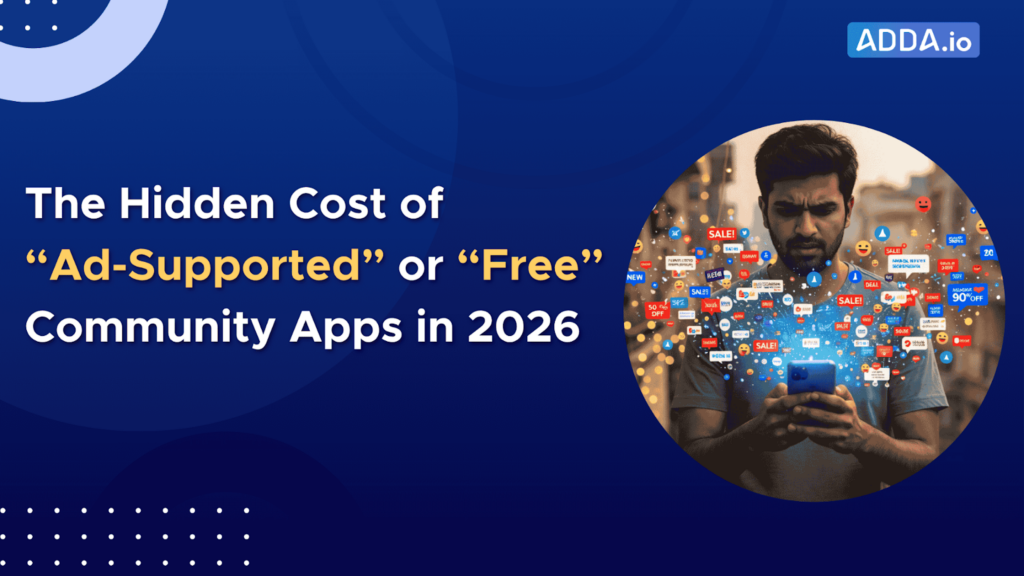
A 1,000-apartment society can lose 90,000 hours of resident productivity every year because of advertisements inside a community app.
Table of Contents
A 1,000-Apartment Community Calculation
What a 1,000-Apartment Community Actually Pays
If you walk into a management committee meeting and say, “Hey, this app is free (or is coming at a nominal cost) let’s start using it!,” most people will nod immediately.
After all, what could be better than free software?
No subscription. No yearly payment. Sometimes even the security devices come at no cost. On paper, it feels like the society has just saved lakhs of rupees.
But give it a few months.
Residents start receiving promotional notifications. Screens inside the app begin filling up with advertisements. People open the app to check a water shutdown announcement but first have to swipe past an insurance offer or a lucky draw banner.
Slowly, the community begins paying for that “free” software in a different currency.
- Time.
- Attention.
- Productivity.
- And occasionally, privacy.
Before we go deeper, let us look at what a typical community actually looks like.
Let us look at the numbers for a typical 1,000-apartment community.:
- Say there are 1,000 apartments
- ~3,000 residents living in the community
- Around 5 promotional notifications are sent to residents per day
- Ads occupies 50–70% of the app screen
| Impact Area | What Happens in an Ad-Driven Community App | Estimated Community Impact |
| Resident Productivity Loss | Residents receive multiple ad notifications daily, which causes a break of concentration from work. It takes some time to come back to the productive zone. Residents must navigate through ad-heavy screens to find actual community information. | 250 hours of resident productivity lost per day (3,000 residents × 5 minutes). 91,000+ hours lost annually. |
| Estate Management Time Loss | Residents miss announcements and call estate managers or MC members for updates already posted in the app. | 2–3 hours of community staff time lost every day. 900+ hours lost annually. |
| Communication Effectiveness | Advertisements dilute the visibility of important community announcements. | Residents start ignoring notifications. One MC member can end up wasting ~90 hours per year (if daily just 10 mins is spent repeat updates via WhatsApp, calls, and emails) |
| Privacy & Data Risk | Promotional campaigns inside the app encourage residents to submit personal data for offers or registrations. | 12–18 households in a typical community may unintentionally share personal data with vendors. Increased spam and scam risk. This may cause Lakhs of money loss for affected residents. |
| Regulatory Risk (DPDP Act) | Under India’s Digital Personal Data Protection Act, Management Committees are considered Data Fiduciaries responsible to make sure residents data is not used for purposes outside society communication & operations without Explicit Consent. | If resident data is used for promotions without explicit consent, communities may face regulatory penalties up to ₹250 crore. |
| Operational Friction | Residents begin using the app only for visitor approvals and ignore other features due to ad clutter. | Helpdesk usage drops, complaints shift to phone calls, and operational efficiency declines. |
1. Resident Productivity Loss
Advertisement-driven apps constantly compete for attention. Ad-Based community Apps send at least 5 to 10 notifications everyday, which are marked as Notices.
Imagine this, you are in between some deep work, and you get a notification in your community app marked “Notice”. Your attention is bound to go towards it. And then you realise it is an Ad. What actually happens is you are out of your productive zone, and getting back takes some time. Each interruption pulls the resident away from their work or daily activity.
Also when residents open the app to perform tasks such as raising complaints or booking amenities, they must navigate through ad-heavy screens.
Now imagine this happening several times a day.
It may seem trivial in that moment. But when 3,000 residents lose just five minutes every day, the math suddenly becomes interesting.
Even if we assume a moderate estimate:
Each resident loses 5–10 minutes per day due to ad notifications, distraction, and navigating through ads.
Community Impact
If we take the lower end of this estimate:
5 minutes per resident per day
Calculation:
3,000 residents × 5 minutes = 15,000 minutes lost per day
That equals:
250 hours of productivity lost every single day
Over a year:
91,250 hours of lost resident productivity
To understand the scale of this:
That is the equivalent of 45 full-time employees worth of productive time lost every year.
And this is happening simply because residents must filter advertisements before finding useful community information.
2. Estate Management Productivity Loss
Take the example of a community in Bengaluru with about 450 apartments.
One evening, the management committee posted an announcement inside their app about a planned water shutdown the next morning.
The update was clear. The timing was mentioned. Everything was in the system.
Yet the next morning the estate manager received more than thirty phone calls.
“Why is the water not coming?”
“Was there an announcement?”
“Why didn’t anyone inform us?”
Later they realised something interesting. The notification had been sent correctly, but it appeared in between two promotional alerts that residents had already started ignoring.
One MC member laughed about it later and said,
“At this point, our WhatsApp group is doing more work than the app we installed.”
It was meant as a joke. But it reflected a real communication breakdown.
Once residents stop trusting the app as the main communication channel, they start contacting the estate manager or management committee directly for queries, updates, etc.
Typical queries include:
- maintenance invoice questions
- water shutdown or lift outage or such community related updates
- clubhouse timings
- event schedules
- complaint updates
These questions often arise because residents missed the notification inside the app.
Typical Daily Scenario
In a 1,000-unit community, it is common to see:
30–50 calls or messages per day asking for updates already posted in the app.
If each interaction takes:
3–5 minutes
Daily time lost:
40 queries × 4 minutes = 160 minutes per day
That equals:
2.5 hours of staff time lost every day
Over a year:
900+ hours of operational productivity lost
That is more than 4 months of working time, spent simply repeating information that already exists in the system.
3. Increased Risk of Personal Data Exposure
Advertisement-driven platforms often include promotional campaigns that encourage users to:
- register for free samples
- participate in lucky draws
- claim discount coupons
- sign up for promotional offers
These campaigns typically capture personal information such as:
- phone number
- email address
- apartment details
- vehicle information
- date of birth
The consent terms are often hidden in small text, which many users may not notice.
Risk to Senior Citizens
In most residential communities:
• 20–30% of residents are senior citizens
In a 3,000 resident community:
600–900 residents may be senior citizens
If even 2% accidentally submit personal data through promotional forms, which gets sold to spammers for money by the Ad First Community App, (while they will justify telling that you shared the data yourself by clicking on the button), for the residents this means:
12–18 households sharing personal data with external vendors.
This can result in:
• spam calls and targeted marketing
• phishing attempts
• financial scams
Even a single scam incident can lead to ₹20,000 – ₹1,00,000 financial loss for the affected household.
For management committees, this creates a serious concern because the community platform is supposed to be a trusted environment, not a marketing channel.
4. Communication Breakdown
Once residents stop trusting the app as the main source of updates, they fall back to the easiest option.
They call someone.
Usually the estate manager. Sometimes an MC member.
Typical questions sound like this.
“Has the maintenance invoice been generated?”
“What time does the clubhouse close today?”
“Did the lift maintenance happen?”
“Is the Diwali event confirmed?”
In most cases, the answer is already available in the app.
But the resident missed it.
In a 1,000-apartment community, this can easily mean 30 to 50 queries every day asking for information that was already posted.
If each conversation takes four minutes, that becomes around 160 minutes of staff time daily.
Which means the estate management team spends two and a half hours every day repeating information.
Over a year, that becomes more than 900 hours of operational time lost.
One estate manager once described it perfectly.
“Some days I feel like Google for the society. People ask questions whose answers are already in the app.”
When advertisements dominate the app experience, residents gradually stop paying attention to actual important notifications coming from the community management team.
The app becomes associated with marketing rather than important community updates.
The result is:
- residents miss announcements
- residents rely on WhatsApp groups again
- estate managers repeat the same updates multiple times
- committees struggle to maintain communication clarity
Over time, the digital platform that was meant to simplify communication ends up creating more manual work instead of reducing it.
5. The Hidden Regulatory Risk for Management Committees
Under the Digital Personal Data Protection Act (DPDP Act), 2023, Management Committees of housing societies are considered Data Fiduciaries.
This means the MC is legally responsible for ensuring that resident data:
- is collected only for legitimate society purposes
- is not used for promotions without explicit consent
If resident data is used for advertising or promotional campaigns without proper consent mechanisms, the community could face serious regulatory scrutiny.
The DPDP Act allows penalties of up to ₹250 crore for severe violations related to misuse of personal data.
This makes the choice of community technology platform extremely important.
Platforms that depend on advertising often mix promotions with community communication, increasing the risk of resident data being used beyond its original purpose.
This is why many communities now prefer platforms that are built with privacy-first architecture and explicit consent management, rather than advertising-based models.
What Is the Real Cost of a “Free” Community App for a Housing Society?
At this point, many communities start seeing the irony.
Yes, the software itself may cost zero.
But the community ends up paying through:
- 90,000+ hours of resident productivity lost every year
- 900+ hours of estate management time spent repeating updates
- increased privacy risks from promotional campaigns
- communication breakdown when residents ignore notifications
When you compare that with the cost of a proper community management platform, the difference is quite striking.
Most full community ERP platforms cost less than one rupee per apartment per day.
That is roughly the price of a single cup of tea per apartment every month.
For that small cost, the community gets a platform focused purely on community management, not advertising.
Why Are Many Large Apartment Communities Moving to Ad-Free Community Platforms?
After living with these challenges for a while, many MC members reach a simple realisation.
If a platform causes thousands of hours of lost productivity, creates privacy risks, and forces staff to repeat the same information every day…
Is it really free?
That is why many larger communities eventually move toward subscription-based platforms that do not depend on advertising revenue.
Platforms like ADDA follow this approach.
Because ADDA does not rely on advertisements, the app remains clean and focused. Residents can approve visitors, raise complaints, check announcements, or book amenities without navigating through promotional clutter.
Which is exactly what a community platform is supposed to do.
And frankly, what most residents expect when they open the app in the first place.