If you observe enough housing societies over time, a pattern starts to emerge.
Most communities do not jump directly into sophisticated management systems to begin with. They grow into them.
In the early days, the focus is usually on solving the most visible problem. Later, as more residents move in and the management committee begins handling real governance responsibilities, they need a platform which can take care of those more complex demands.
Across thousands of apartment communities, the journey usually moves through three stages.
Some societies move through these stages quickly. Others stay stuck in the first stage for years and struggle with operational chaos.
Let us look at how this usually unfolds.
Table of Contents
Why Do New Apartment Communities First Adopt Visitor Management Systems?
When a new apartment complex becomes occupied, the biggest concern residents have is security at the gate.
People want to know who is entering the premises. Delivery agents, guests, service staff, cab drivers, everyone needs to be tracked. The security guards at the gate also need a system that helps them manage entries without relying on paper registers.
This is why many communities first adopt visitor management tools.
These systems make the entry process digital. Residents receive a notification when someone arrives. They can approve deliveries, allow guests, or deny entry directly from their phone.
In the early days, this solves a very real problem.
Many of these tools are also introduced with an attractive offer. The devices may come free. SIM cards are provided. The setup looks quick and easy.
For a newly occupied society that simply wants better gate security, this feels like the perfect solution.
And to be fair, at this stage it works reasonably well.
But once a few hundred families start living in the community and the management committee takes over operations, the scope of responsibility grows far beyond the gate.
What Operational Challenges Do Management Committees Face as Communities Grow?
Once the community becomes fully occupied, running the society begins to look less like security management and more like running a small organization.
Suddenly the management committee is responsible for multiple areas that require proper technology and systems.
- Maintenance billing and collections become a regular task. Every apartment must receive invoices, payments must be tracked, and defaulters need to be identified. Handling this through spreadsheets quickly becomes messy.
- Vendor payments and expense approvals also start piling up. Housekeeping vendors, lift maintenance companies, electrical contractors, gardening teams, all of them generate bills that must be reviewed and approved.
- Complaint management becomes another major area. Residents raise issues about plumbing, electricity, parking disputes, or facility maintenance. If these complaints are not tracked properly, things fall through the cracks and residents become frustrated.
- Facility bookings also increase as more families begin using amenities like the clubhouse, sports courts, or party halls. Without a structured booking system, double bookings and conflicts become common.
- Communication inside the society becomes another challenge. The committee needs to send announcements, policy updates, and event information to hundreds or sometimes thousands of residents.
- And then there are governance responsibilities. Annual General Meetings must be conducted properly. Elections may need to be organized. Financial records must be maintained in a way that auditors can review.
Many committees discover at this stage that tools designed mainly for visitor approvals do not provide the depth needed to manage all these responsibilities.
A few common frustrations begin appearing.
- Visitor management apps which came free early on clutter the communication channel with residents with advertisements, making important announcements easy to miss.
- Financial reporting of these Ad based tools are heavily limited, forcing the treasurer to export data and prepare manual reports.
- Operational information becomes scattered across emails, spreadsheets, WhatsApp messages, because resident stay away from Spammy Community Apps
- Activities like conducting a digital vote or organizing an AGM often require additional tools or manual processes.
At this point the management committee starts realizing that the society needs something more structured.
Why Do Mature Apartment Communities Adopt Full Community ERP Platforms?
Once a community reaches this stage, the conversation inside committee meetings changes.
Instead of asking, “How do we manage gate entry?” the question becomes, “How do we manage the entire community efficiently?”
Communities with several hundred homes generate a surprising amount of operational activity. Financial transactions, complaints, service requests, communications, vendor coordination, and governance decisions all need to be recorded and managed properly.
This is where comprehensive community management platforms come into the picture.
- A full community ERP platform is designed to handle the different functions of a residential complex in an integrated way.
- Financial management becomes structured. Maintenance billing, payment tracking, defaulter reporting, and audit-ready financial records are all handled within the system.
- Complaint management becomes organized. Residents can raise requests, the estate team can assign them to vendors or staff, and everyone can track progress until the issue is resolved.
- Communication becomes clearer because announcements are delivered in a focused environment without promotional distractions.
- Governance tools allow committees to conduct digital voting, organize AGMs, and maintain proper records of decisions taken by the association.
- Operational data also becomes easier to review. Committees can see reports about finances, complaints, facility usage, and other community activities without relying on manual compilation.
This is the stage where many communities move toward dedicated platforms like ADDA.
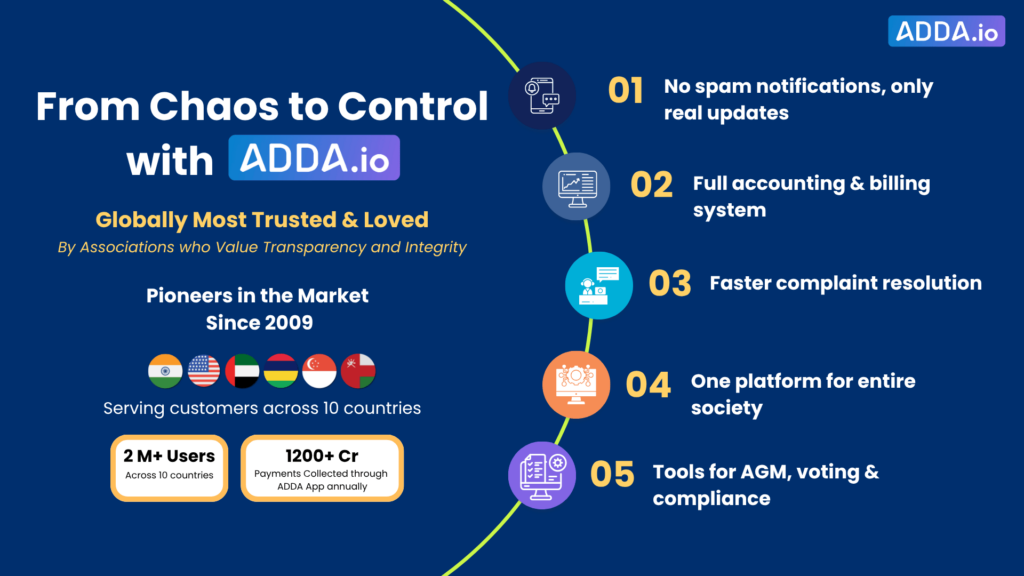
ADDA was designed specifically for residential community management. Instead of focusing only on gate entry or notifications, it combines communication, finance, operations, and governance into one system.
For management committees, this means the entire ecosystem of the community can run on a single platform built for exactly this purpose.
Which Stage Is Your Housing Society Currently In?
If you look at your own community, you will probably recognize one of these stages.
Many societies begin their journey with simple security tools that help manage visitor entry. That is a natural first step.
But as the community grows and governance responsibilities expand, the limitations of basic tools start becoming visible.
Running a residential complex with hundreds or thousands of residents requires systems that support finance, operations, communication, and governance in a structured way.
The question every management committee eventually asks is quite simple.
Is our community still operating with tools designed only for Stage 1, or are we ready for the systems needed at Stage 3?
Communities that adopt mature platforms earlier usually notice several positive changes.
Operational transparency improves because financial and service records are organized.
Administrative workload reduces because many manual tasks become automated.
Complaint resolution becomes faster since requests are tracked clearly.
Residents begin trusting the system more because communication and governance processes become transparent.
Financial management also becomes easier for treasurers and auditors.
This is why thousands of large residential communities across multiple countries rely on platforms like ADDA to manage their daily operations.
Because at a certain scale, running a housing society stops being a small volunteer activity and starts looking a lot like managing a well-run organization.
And like any organization, it needs the right systems to function smoothly.