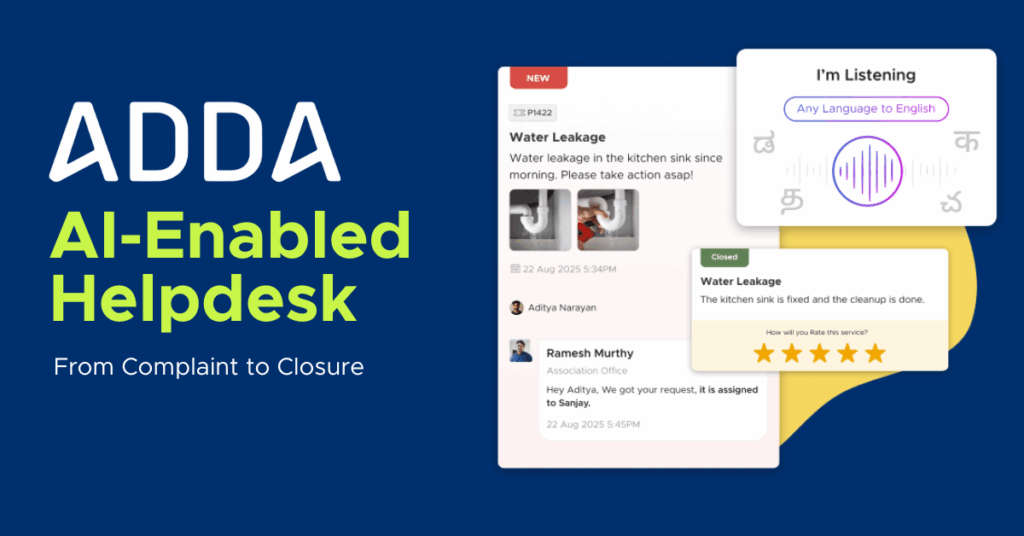
In every Indian housing society, daily life depends on how quickly problems get solved. A leaking pipe, a faulty lift, a broken light in the parking area, these are not “small issues.” They directly impact comfort, safety, and trust in the management committee.
But here’s the real question:
What happens between a complaint and its closure?
That journey from frustration to resolution, defines resident experience. And this is exactly where ADDA Helpdesk (ADDA Desk) transforms how societies function.
Table of Contents
What is the Situation of a Housing Society Without Structured Helpdesk
Most Indian RWAs still rely on:
- Phone calls
- WhatsApp groups
- Verbal complaints
- Registers or Excel sheets
At first, it feels manageable. But as the society grows, problems begin to surface.
What Residents Experience
- Uncertainty about whom to contact
- Multiple follow-ups
- No clarity on status
- Delays because the “right person” is unavailable
- Frustration due to lack of updates
A simple water leakage can turn into a 3-day escalation just because the manager was on leave and no one tracked the issue.
What RWAs Experience
- No visibility into staff workload
- No tracking of recurring issues
- No SLA monitoring
- No structured escalation mechanism
- No performance data
This creates chaos, finger-pointing, and rising dissatisfaction.
Why Modern Indian Housing Societies Need Structure
Today’s residential complexes operate like mini-cities:
- Plumbing teams
- Electrical staff
- Housekeeping crews
- Security operations
- Vendors and contractors
Residents expect digital convenience. They expect transparency. They expect accountability.
Without a centralized helpdesk system, complaints slip through the cracks, and trust erodes silently.
How ADDA Helpdesk Changes the Game
ADDA Desk brings structure, automation, and transparency to society operations.
Instead of informal complaint handling, every issue becomes:
- Logged
- Assigned
- Tracked
- Updated
- Closed with feedback
Let’s break down how this transforms daily life.
1. Effortless Complaint Raising for Residents
Residents can:
- Raise tickets via the app
- Use voice input in their native language
- Upload photos for clarity
- Specify preferred service slots
AI-powered ticket creation auto-translates and categorizes issues correctly. No confusion. No wrong routing.
Impact: Seniors and non-tech-savvy residents can participate easily.
2. Automatic Routing & Zero Confusion
Once a complaint is raised:
- It is instantly assigned to the correct category (plumbing, electrical, housekeeping, etc.)
- The right staff member receives it
- No manual triaging needed
This eliminates the common “I didn’t get the message” excuse.
3. Real-Time Updates = Zero Anxiety
Residents receive:
- Status updates
- Technician assignment details
- Photos of completed work
- Service schedule notifications
No repeated calls. No chasing.
Two-way communication happens inside the ticket itself, not across scattered WhatsApp chats.
4. Accountability for Staff & Vendors
Every action is time-stamped.
- Staff update tickets with notes and images
- Vendors only see assigned tasks
- Access is role-based and secure
- Escalations happen automatically if delays occur
No lost complaints. No “shift change excuses.” No bypassing processes.
5. Complete Visibility for RWAs & Management Committees
For MCs and RWAs, the real power lies in data.
They get:
- Category-wise issue trends
- Staff utilization reports
- Turnaround time tracking
- SLA compliance monitoring
- Satisfaction scores
- Contractor performance analytics
Instead of reacting to complaints, RWAs can now:
- Identify recurring structural issues
- Detect underperforming vendors
- Plan preventive maintenance
- Improve service quality proactively
This strengthens governance and reduces future escalations.
6. Escalation Management for Critical Issues
Emergency complaints like:
- Water leakages
- Electrical hazards
- Security faults
Are auto-escalated if not addressed within defined timelines.
This ensures serious issues don’t remain buried in a message thread.
7. Service Catalog & Revenue Transparency
Societies can also:
- Publish paid in-unit services
- Allow residents to book and pay within the app
- Track completion with accountability
No cash confusion. No informal vendor coordination.
The Real Transformation: From Chaos to Predictability
When a structured, technology-driven helpdesk replaces scattered phone calls, WhatsApp messages, and verbal complaints, the shift is more than operational, it is cultural. Processes become transparent. Accountability becomes measurable. And daily friction reduces dramatically.
Instead of chasing updates and clarifying misunderstandings, communities begin operating with clarity and predictability.
For Residents
- They feel heard
Every complaint, request, or suggestion is logged, acknowledged, and tracked. There is no ambiguity about whether an issue was “seen” or “missed.” Automated notifications and status updates give residents visibility and assurance. - They feel respected
Structured ticketing ensures fair prioritization instead of influence-based resolution. Every resident, regardless of their role or tenure, gets equal treatment through a transparent process. - They trust the management
When response times improve and communication becomes documented and consistent, trust grows organically. Residents see data, not promises. This strengthens long-term confidence in the RWA or managing committee.
For Staff
- Clear responsibilities
Tasks are assigned digitally with deadlines and accountability. There is no confusion about who is handling what, reducing overlaps and missed requests. - Less manual coordination
Staff no longer spend hours fielding repeated calls, searching for handwritten notes, or clarifying incomplete information. Everything is centralized in one system. - 40%+ time savings reported by communities
By reducing follow-ups, duplicated work, and manual tracking, many communities experience significant efficiency gains. Staff can focus on preventive maintenance and service quality rather than reactive firefighting.
For RWAs and Management Committees
- Transparent governance
Every complaint, action, and resolution is documented. This minimizes allegations of bias or negligence and strengthens governance credibility. - Data-backed decisions
Recurring issues can be analyzed through reports and dashboards. Instead of relying on anecdotal feedback, committees can allocate budgets and resources based on actual patterns and trends. - Reduced escalations in AGMs
With a clear digital trail of communication and resolution timelines, conflicts are resolved earlier, preventing unnecessary escalations during Annual General Meetings. - Stronger community harmony
When systems replace chaos, emotional friction reduces. Clear processes reduce misunderstandings, and predictable outcomes foster cooperation among residents, staff, and management.
The Bottom Line
- A structured helpdesk does more than organize complaints, it transforms community dynamics.
It replaces uncertainty with visibility, emotion with process, and chaos with predictable, measurable outcomes.
Complaint → Ticket → Assignment → Update → Closure → Feedback
That simple, predictable flow changes daily society life.
- It turns emotional arguments into measurable processes.
- It turns frustration into structured resolution.
- It turns reactive management into professional governance.
Why This Matters for Indian Housing Societies
Indian housing societies are growing larger and more complex. Expectations are rising. Compliance standards are tightening. Residents demand digital experiences.
An unstructured complaint system is no longer sustainable.
A privacy-first, AI-enabled, structured helpdesk is not a luxury, it is essential infrastructure.