It is month-end at a commercial complex. Most shops have closed for the day, but Mr. Bansal is still in his office.
Maintenance bills need to go out for more than 100 shops. Some tenants have paid, some have asked for more time, and a few still have dues from the previous month. The electricity vendor has been calling since the afternoon, and the security agency invoice is also pending.
Someone walks in and asks how much is still outstanding from the tenants. Mr. Bansal does not know the exact number. He opens multiple Excel files, checks entries one by one, and calculates the total manually. By the time he has an answer, it is late, the vendor is still waiting, and there is no clarity on whether the balance in the account is enough to cover everything that is due.
This is not a bad month for Mr. Bansal. This is every month. And for most commercial property managers handling accounts manually, this kind of pressure has just become part of the job.
ADDA is built for commercial properties like these, where billing, collections, expenses, and accounting need to be in one robust system, so month-end does not have to look like this.
Table of Contents
Why Managing Accounts for a Commercial Property Is Not Simple
Managing accounts for a commercial complex is very different from managing accounts for a small office or a single business.
In a commercial building, there can be more than 200 shops or office units. Every month, maintenance has to be billed for each one of them. Payments come in at different times from different tenants. Vendors are waiting to be paid. And through all of this, the accounts have to stay accurate and up to date.
In many commercial complexes, the yearly financial turnover runs into rupees 30 to 40 crore. At that scale, a small mistake in billing or a missed payment does not just create confusion; it can lead to compliance issues, vendor disputes, and financial gaps that take weeks to sort out.
Many commercial properties still manage all of this using Excel sheets or basic accounting tools. This works when the property is small. But for commercial spaces with a large number of units, keeping everything in Excel starts taking more and more time, and it increases loss due to human error.
Accounting Problems Commercial Properties Deal With Every Month
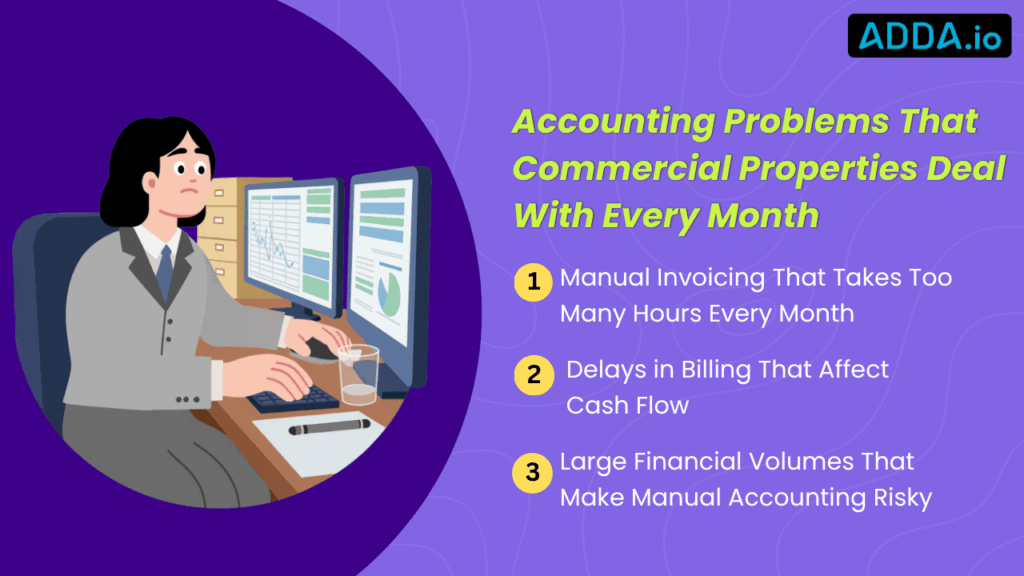
Most commercial properties managing accounts manually face the same problems every single month.
Manual Invoicing That Takes Too Many Hours Every Month
In a commercial complex with 150 to 200 units, each bill has to be prepared separately, checked against the previous month, and sent out individually. Payments have to be tracked one by one, and accounts updated after each collection. For many commercial properties, this process alone takes 10 to 15 hours every month, and even after all that, there is always a chance something has been missed.
Delays in Billing That Affect Cash Flow
Maintenance needs to be collected on time every month so that day-to-day expenses can be met. When billing gets delayed, collections get delayed. And when collections are delayed, vendor payments start getting affected too.
Electricity bills, security agency payments, housekeeping, and repairs still have to be paid on time regardless of whether tenants have paid. Even a small delay in the billing cycle creates pressure on the entire operation.
Large Financial Volumes That Make Manual Accounting Risky
When a commercial property is handling rupees 30 to 40 crore every year, there are hundreds of transactions to keep track of. At that volume, managing everything manually means there is always a risk of something being missed or entered incorrectly. And when audit time comes, finding the right numbers, matching entries, and fixing mismatches can take days. It needs a lot of time and adds pressure on one person or a small team trying to get it all right.
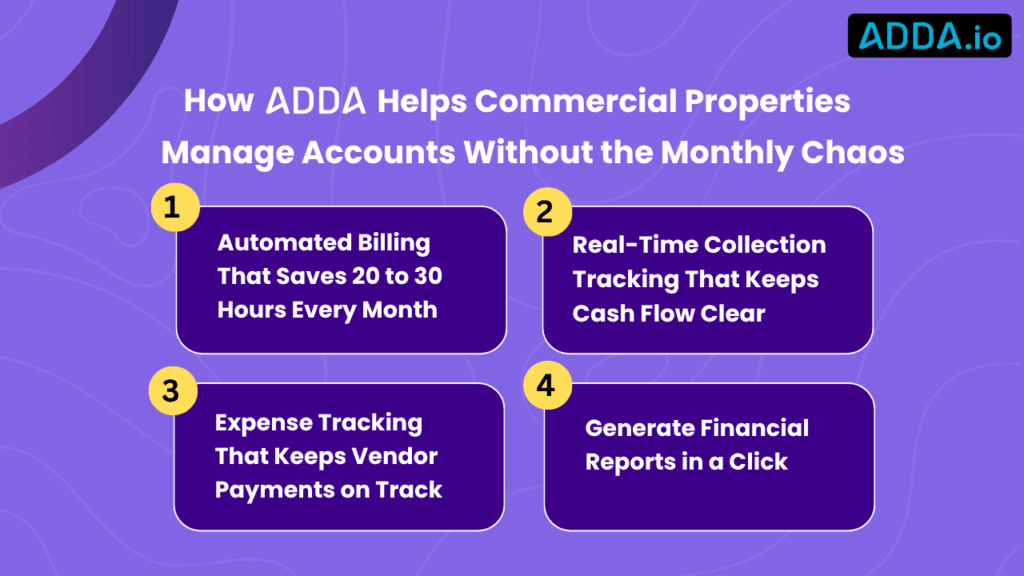
How ADDA Helps Commercial Properties Manage Accounts Without the Monthly Chaos
ADDA is built for commercial properties that manage multiple units, regular billing, vendor payments, and financial reporting every month. Billing, collections, expenses, and accounts all work together in one official, robust system.
Automated Billing That Saves 20 to 30 Hours Every Month
With ADDA, invoices for all units can be generated in minutes, without preparing bills one by one or updating entries in Excel. For commercial complexes with 150 to 200 shops or office units, this saves 20 to 30 hours of manual work every month
Real-Time Collection Tracking That Keeps Cash Flow Clear
Payments made by tenants are recorded directly in the system. The manager can see who has paid and who has not, without opening multiple files or checking entries one by one. The available balance is always clear, so vendor payments can be planned without any last-minute confusion.
Expense Tracking That Keeps Vendor Payments on Track
Electricity bills, security payments, housekeeping, repairs, and other recurring expenses can all be tracked in one place. The manager always knows what is due and when, so nothing gets delayed because something was missed.
Generate Financial Reports in a Click
Since billing, collections, expenses, and bank entries are all connected in one system, accounts stay updated automatically. Financial reports can be generated at any time, which makes monthly closing, audits, and reviews much simpler. The numbers are already in order, so there is no last-minute scramble to put reports together.
A Better Way to Manage Commercial Property Accounts
Managing accounts for a large commercial property is already a lot of work. Doing it manually makes it harder than it needs to be. As the number of units and transactions grows, keeping bills, payments, and reports in order takes more time, and even small mistakes can create bigger problems later.
ADDA brings all of this into one place, so the accounts are always in order, and month-end is not something the team has to dread.
Well-managed communities increase property value and harmony. And that starts with getting the accounts right.
Commercial properties that want to see how ADDA can work for their setup can book a demo with the ADDA team today.
Book a Demo with ADDA
Frequently Asked Questions
Q1. What are the essential features of accounting software for commercial landlords?
Commercial properties usually have many shops or office units, regular maintenance billing, and frequent vendor payments.
So accounting software should support unit-wise billing, payment tracking, expense management, and clear financial reports.
With ADDA, commercial landlords can generate bills for each unit, track collections, record expenses, and view reports in one place, which makes it easier to manage large properties without manual work.
Q2. Best accounting software with invoicing and rent tracking for commercial properties
For commercial complexes, invoicing and payment tracking need to be done regularly and for multiple tenants at the same time.
Using basic accounting tools often makes it difficult to know who has paid and what amount is still pending.
ADDA allows managers to generate invoices automatically, record payments directly in the system, and see pending dues instantly, which makes rent and maintenance tracking much simpler for commercial properties.
Q3. How to choose accounting software for commercial properties
When selecting accounting software for a commercial property, it is important to choose a system that is built for property management, not just general accounting.
The software should be able to handle multiple units, recurring billing, vendor expenses, and financial reports without depending on separate tools.
ADDA is designed specifically for community and commercial property management, so billing, collections, and accounting stay connected as the property grows.
Q4. Affordable accounting solutions for commercial property management
Affordable software should not only be low-cost but should also reduce the time spent on manual work every month.
If accounts are managed in Excel, many hours go into preparing bills, checking payments, and matching reports.
With ADDA, most of this work is automated, which saves time every month and helps commercial property managers avoid errors that usually happen with manual tracking.
Q5. Best practices for selecting a financial system for multiple commercial properties
When managing more than one commercial property, the financial system should allow accounts to be maintained separately while still keeping everything in one platform.
Property managers should look for software that can handle billing, collections, expenses, and reports for multiple properties without confusion.
ADDA makes this easier by allowing managers to manage several commercial properties in one system while keeping the accounts organised for each property.