
Managing a housing society in India is a balancing act between maintaining discipline and ensuring resident satisfaction. For most Management Committees (MCs) and Apartment Owners Associations (AOAs), imposing fines is the go-to tool for enforcing rules. However, when handled poorly, these penalties can lead to conflicts and fractured community relations.
Table of Contents
Why Are Housing Society Fines So Controversial?
In the context of Indian Cooperative Housing Societies (CHS) and gated communities, fines often become a flashpoint for disputes. The most common reasons include:
- Arbitrary Decision Making: Fines are often decided on the spot without a formal resolution or documented proof.
- Lack of Uniformity: Rules are applied inconsistently—penalizing one resident for a violation while overlooking another.
- No Legal Basis: Many societies impose “spot fines” that are not supported by the Model Bylaws or the State Apartment Ownership Act.
The Legal Position: What the Law Says
In India, a housing society is a legal entity governed by its registered bylaws. According to the law:
- Bylaws are Supreme: A society cannot fine a resident for something not explicitly mentioned in its registered bylaws or a resolution passed in the Annual General Meeting (AGM).
- Due Process is Mandatory: You cannot simply add a penalty to a maintenance bill. The resident must be served a formal notice and given an opportunity to respond.
Best Practices for Conflict-Free Governance
To ensure your society rules are respected, it is important to not make it look like “policing” and toward structured processes towards community guidelines management and violation tracking.
- Issue Formal Warnings: Always start with a digital warning. Often, a gentle reminder via your apartment maintenance app is enough to correct the behavior.
- Document Everything: Never levy a fine without evidence (CCTV footage, photographs, or witness logs).
- Standardize the Process: Ensure the penalty amount is fixed for everyone. For example, if the fine for “not picking up pet waste” is ₹2,000, it must remain the same regardless of who the resident is.
How can ADDA help with Lawful Rule Enforcement?
Digital transformation is the easiest way to remove “human bias” from society’s penalties. ADDA ERP, the best apartment facility management software, provides specialized features to handle these sensitive matters with absolute transparency:
1. ADDA Community Guidelines Module
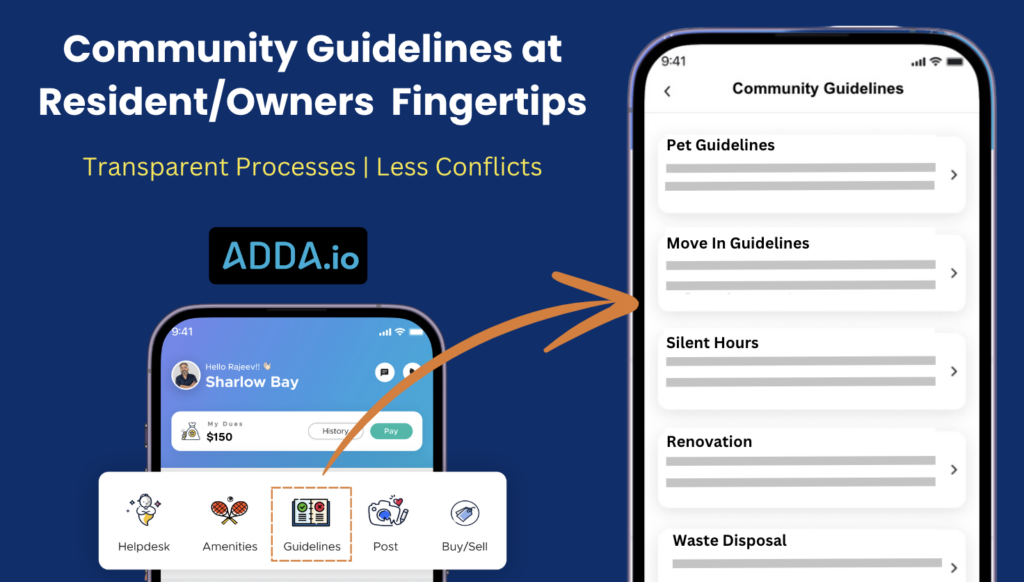
The key to conflict-free governance isn’t just having rules, but how the Management Committee and housing society associations publish and communicate the rules and guidelines.
The trick to effective enforcement lies in three pillars:
- Establish One Official Channel: Eliminate the chaos of unofficial WhatsApp groups or ad based community apps. Use a distraction-free, society-focused platform like ADDA with a community guidelines module as your official platform for rules and regulations.
- Keep Guidelines at Fingertips: Rules shouldn’t be buried in a PDF in someone’s email or inside ad filled community apps. They must be readily accessible in the ADDA SuperApp so residents can reference them instantly.
- Onboard Early: Introduce community guidelines to owners and residents right during the move-in process, so there are no communication gaps in the future.
With ADDA’s Community Guidelines Module, management committee members can publish clear outlines for pet restrictions, parking, noise ordinances and more. Even updates such as changing pool hours can be reflected instantly, so that every member of your smart community is kept informed at all times.
2. The Violation Tracker Module
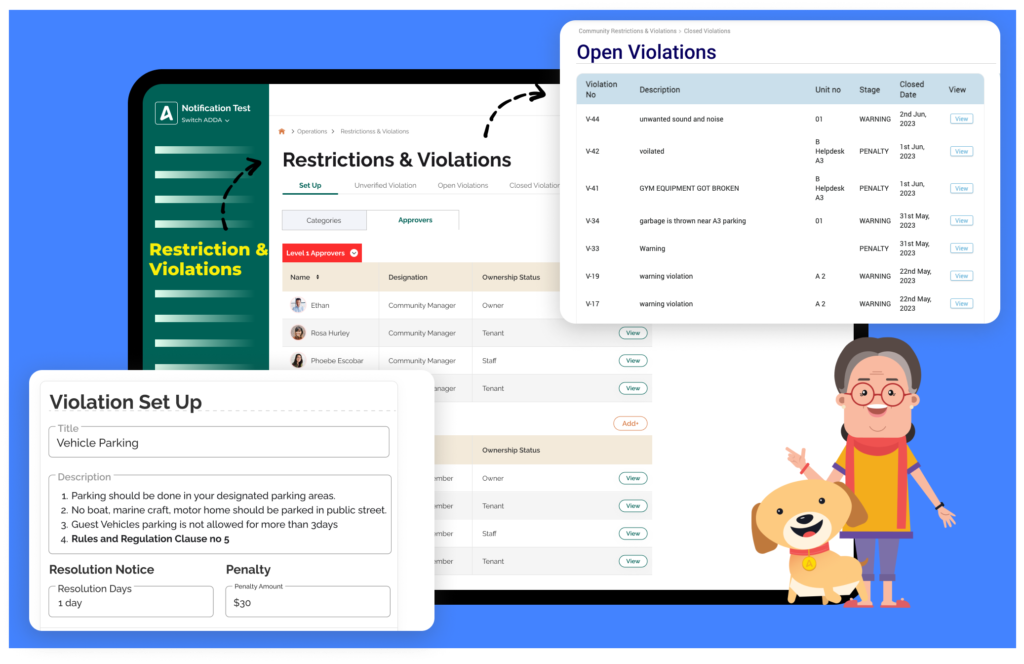
Move away from manual registers. ADDA’s violation tracker module allows the MC to record violations with date, time, and photo evidence, sending automated notices directly to the resident’s app. This feature from the apartment maintenance app module enables Management Committees to move away from manual registers. MCs can:
- Configure Warning & Penalty Logic: Choose to issue a formal warning first or set specific warning durations before a penalty kicks in.
- Set up Approval Levels: Ensure a “no-conflict” process where violations go through a multi-level approval workflow before being published.
- Maintain Confidentiality: The identity of the individual reporting the violation from the apartment maintenance app remains strictly confidential to maintain community harmony
3. ADDA Billing: Transparent Financial Control
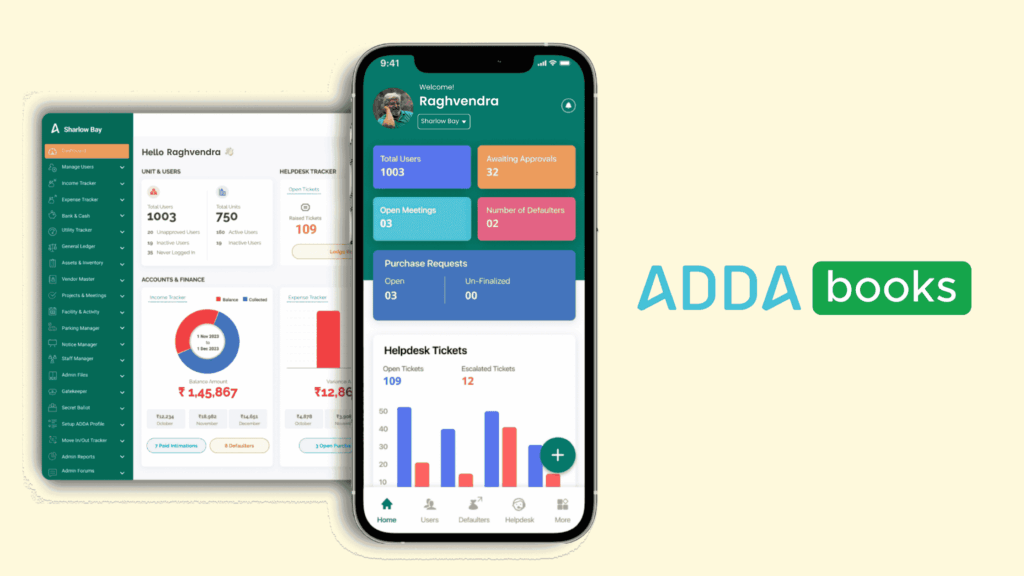
One of the biggest causes of friction is a “surprise” penalty on a maintenance bill. With ADDA Books, the process of managing expenses in housing societies becomes error-free.
- Formula-Based Penalties: ADDA Books eliminates human error by calculating penalties based on pre-set formulas approved in the bylaws.
- Separate Invoicing for Penalties: Residents receive clear bills for penalties separately from maintenance bills.
4. ADDA Desk: Accountability in Resolution
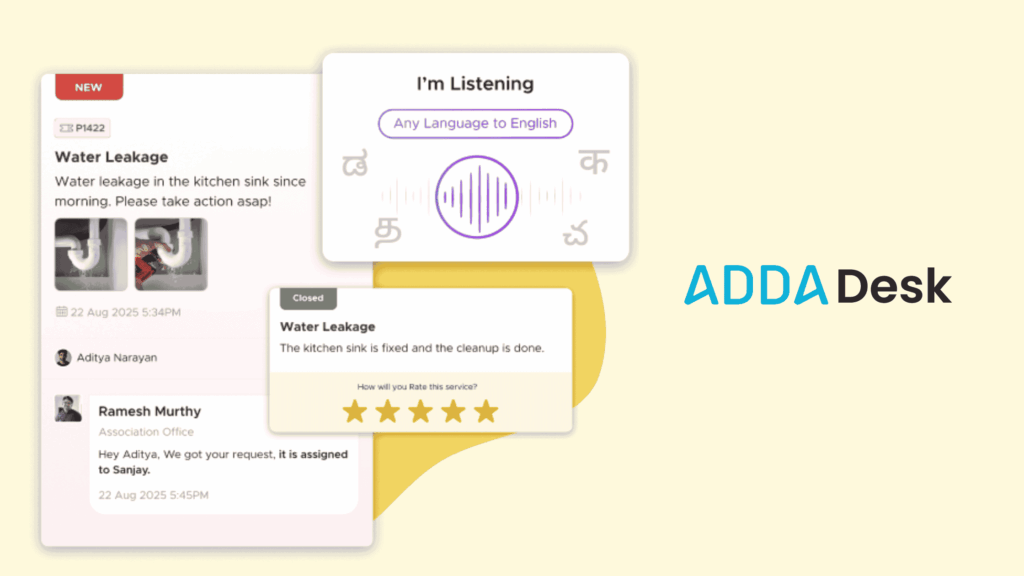
Often, rules are broken because residents feel their grievances aren’t being heard. Here’s how ADDA Desk bridges communication gaps in your society:
- Transparent Communication: If a resident is fined, they can use the ADDA Desk to raise a query or provide an explanation. This ensures a fair “right to be heard” before the fine is finalized.
- Documented History: ADDA Desk maintains a complete history of complaints and responses. This documentation is vital if a dispute ever reaches the Registrar, as it proves the MC followed due process.
- Faster Resolutions: By streamlining maintenance through ADDA Desk, MCs reduce the frustration that often leads to residents ignoring society rules.
Conclusion
Fines should be a last resort. When you replace person-led conflicts with process-led discipline with community management platforms such as ADDA, you ensure a more peaceful, professional, and legally compliant living environment for all.
Frequently Asked Questions
Can a Housing Society MC legally impose fines on residents in India?
Yes, housing society MC can impose fines on residents in India, but only if the power to fine is explicitly mentioned in the society’s registered Model Bylaws or approved via a resolution in the Annual General Meeting (AGM). Any fine imposed without such legal backing or “Due Process”—which includes issuing a show-cause notice—can be challenged in the Cooperative Court or before the Registrar.
What is the maximum limit for fines in a Cooperative Housing Society?
The limit varies by state. For instance, under the Maharashtra Co-operative Societies Act, the maximum fine per violation is typically capped by the General Body, often not exceeding ₹5,000 in a financial year for certain violations. It is essential to check your state-specific Apartment Ownership Act to ensure your penalties are “reasonable” and legally defensible.
How should fine revenue be managed in society accounting?
When managing expenses in housing societies, fine collection should not be mixed with the general maintenance fund. It must be recorded separately, for example, as “Penalty Income” in the books. Using a system like ADDA Billing helps in ensuring these are line-itemed correctly, providing a clear audit trail for the Treasurer during year-end audits.